

One issue that many landscape architects have to overcome when designing for clients is when the grass in that client’s garden does not grow properly, or not at all.
As many landscape architects and garden experts use grass lawns and areas as one of the primary features within their designs, it means they need to consider alternatives.
If you are considering employing a landscape designer, but your grass does not grow, this problem could be down to one of three issues. The first is that the grass is not getting enough sunshine.
This would not normally be a problem in most areas of Australia, but if there is an adjacent large tree or building keeping the grass constantly in the shade, this could be the cause.
The second reason is simply that you are not watering your grass enough or that there is not a proper means of irrigating them. The third problem might be that you are too enthusiastic when mowing your grass, especially if you have the mower set to cut the grass very short.
Finally, the soil in your garden might not have sufficient or the right nutrients that promote grass growth. So, we have two problems you can likely fix and two you probably can’t.
We say “can’t”, assuming that you cannot move large buildings or trees, nor can you change the makeup of the soil in your garden.
However, if this applies to you, all is not lost, because here are 5 ideas that your landscape architect will be able to implement to ensure that your garden’s landscaping design is still something you will love and be proud of.
Install Decking
An option that your landscape architect might suggest to you as an alternative to grass or a concrete patio is decking.
Installing decking would almost certainly require less upheaval than a patio, and would be a cheaper option too. However, it could still be used for most of the same activities that you would partake in on a patio.
You also would have a choice of materials and colours too.
Your new decking should last a while if it’s built correctly with good quality materials, however it can also easily be maintained through deck sanding.
Build A Concrete/Paved Patio
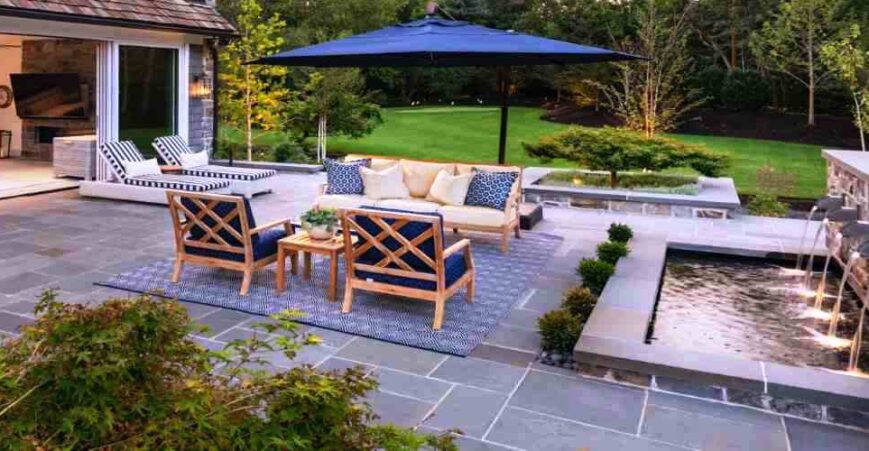
If the grass is simply not going to grow in your garden then instead of having a lawn within your landscaping design, you could ask your landscape designer to include a concrete or paved patio instead.
This would certainly be a low-maintenance option and provide you with an ideal area where you, your family, or guests can sit and enjoy your surroundings. It can also be used for outdoor parties and barbecues.
Substitute Other Plants For Grass
Whilst it might be the case that grass cannot grow in the soil which is under your garden, or the conditions relating to how much sunshine is available, that does necessarily mean it applies to all plants.
If you carry out some soil testing, the result will inform you and your landscape designer which plants would be most suited to that type of soil. You can also choose plants that can thrive with limited amounts of sunshine if that is the issue.
Create A Sunken Garden
This would be a larger undertaking than some of the other ideas, but most professional landscape architects could certainly design and implement it for you. Here you would dig out a large area within the centre of your lawn and ultimately create a sunken garden using concrete and paving stones.
Depending on the size, you could include several plants and features within it.
Artificial Grass
We are sure many gardening purists will hate us for suggesting this, but when you want the best possible looking landscape design to include a lawn, but the grass will not grow there, then this could be your only option.
Artificial grass’ main advantages are that it does not matter what the soil is like or how much sunshine is available. Nor does it require any maintenance so there is one for those of you that want an easy option.